Road to 3 Handicap: My Golf Stats Baseline
14 Aug 2026 · 9 min
Read article
A data-led look at how many greens in regulation a 10 handicap should expect to hit, and why six greens might be more normal than it feels.
If you play off 10 and walk off disappointed because you only hit six greens, you might be being a bit hard on yourself. The numbers suggest six greens is actually pretty normal.
There are certain things in golf that feel worse than they really are.
Missing a green with a wedge is one of them.
You have found the fairway, you have got what feels like a perfectly reasonable yardage left, and then you watch your approach disappear into a bunker or finish ten yards short.
Do that a few times and it is very easy to finish the round thinking:
My iron play was awful today.
But how many greens should a 10 handicap actually be hitting?
Ten?
Eight?
Half of them?
I went looking for proper data, and the answer might make your next missed green slightly easier to stomach.
According to Arccos Golf data, the average 10 handicap golfer hits around 34% of greens in regulation.
Over 18 holes, that works out at:
6.1 greens
So if you are playing off 10 and hitting somewhere around six greens in regulation, you are not having a dreadful ball-striking day.
You are pretty much doing what golfers of your handicap tend to do.
I think that is worth remembering because my instinct would have been that a decent single or low double-figure golfer should be hitting considerably more.
Apparently not.
Before going any further, it is worth clearing this up because GIR is sometimes misunderstood.
A green in regulation means your ball reaches the putting surface with at least two strokes remaining for par.
So:
Hit your approach onto the fringe and it does not technically count, even if you are putting your next shot.
That is one of the reasons GIR can sometimes make your round look slightly worse than it actually was.
You could miss the green by a foot all day and record a terrible GIR percentage.
Another golfer could scrape six approaches onto the very edge of the putting surface and technically have a better GIR day.
Like most golf statistics, it is useful - but it needs context.

This was my first reaction.
A 10 handicap is a pretty competent golfer.
You are capable of breaking 80.
You will probably hit plenty of good iron shots during a round.
Yet statistically you are still likely to miss roughly:
12 greens
That is two-thirds of them.
And that is normal.
For comparison, the same Arccos GIR dataset puts a scratch golfer at around 58% GIR, while golfers in the 0-5 handicap range collectively hit around 52%.
So even a scratch golfer is not wandering around hitting 15 greens every Saturday.
At 58%, they are hitting roughly 10 or 11 greens and missing seven or eight.
That is quite reassuring.
The standard of golf we sometimes expect from ourselves is not particularly realistic.
This is where it gets even more interesting.
Stand in the middle of the fairway with 150 yards remaining and it feels like you should hit the green.
You have got a decent lie.
You have probably got a mid-iron in your hand.
There is no tree in the way.
Surely a 10 handicap should be finding the putting surface more often than not?
Not necessarily.
Arccos has published approach-play data showing that from 125-149 yards, an average 10 handicap hits around 43% of greens.
That is less than half.
And from 150 yards in the fairway, another interesting pattern appears.
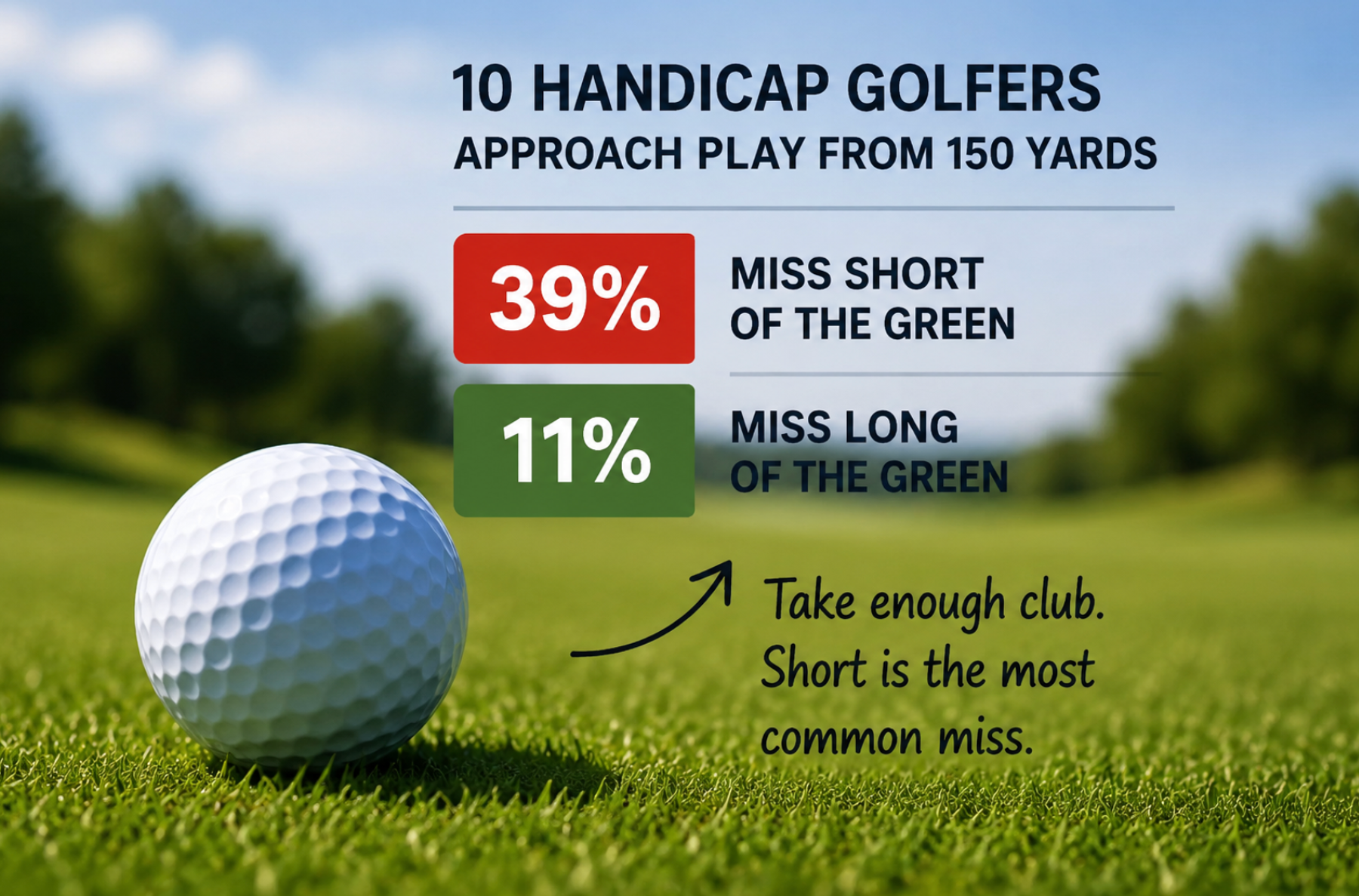
The average 10 handicap finishes more than 10 yards short of pin-high about 41% of the time, compared with only around 11% long.
That one caught my attention.
Because I am guilty of it too.
If there is one thing I would take away from looking at the data, it is this:
Stop assuming the perfect strike.
You stand over 150 yards knowing that you have hit your 8-iron 150 before.
So you pull 8-iron.
But perhaps 150 is what happens when you absolutely flush it.
Your normal shot might carry 142.
Add a slight headwind, a cooler morning, an average strike or an uphill green and suddenly the front bunker is very much in play.
Arccos found that when a 10 handicap plays to a front pin from 150 yards in the fairway, they miss the green short 39% of the time.
That is not always an accuracy problem.
It is often a distance-management problem.
And it is one of the things I am increasingly interested in with Bogeys2Birdies.
We spend a huge amount of time trying to hit the ball better when sometimes we could probably save shots simply by being more realistic about the golfer we actually are.
Definitely.
The fact that six is average does not mean six should be the target.
If you are trying to get your handicap down, increasing GIR is one of the more obvious places to look.
But I would set realistic targets.
And if you hit 12 one weekend, enjoy it.
Do not immediately decide that 12 is your new normal.
Golf has a wonderful way of correcting that sort of optimism the following Saturday.
This is the part of GIR I think matters more than the actual percentage.
Imagine two par 4s.
On the first, you hit the green and leave yourself 30 feet.
You are not exactly dancing around celebrating the approach.
But you have got a putt for birdie and two putts gives you par.
On the second, you miss the green.
Now you need to choose the right shot, judge the lie, control the landing point, get the ball reasonably close and hole the putt.
There is simply more that can go wrong.
This is why hitting more greens matters.
It is not necessarily about creating loads of birdies.
It is about making par easier.
Arccos also notes in its approach stats explanation that more greens usually mean better scoring, although proximity still matters.
That is an important distinction.
There is an obvious trap here.
You read that better golfers hit more greens and decide:
Right. I need to attack more pins.
That could actually make things worse.
If the flag is tucked five yards from a bunker, firing directly at it gives you very little margin for error.
Aim more towards the middle of the green and the exact same swing might finish safely on the putting surface.
That is something I want to test properly as part of the Bogeys2Birdies Project:
Not theoretically.
Actually do it for a defined period and see what happens to:
Because if I can increase GIR without changing my golf swing, that is a pretty cheap way of getting better.
There is another side to this.
Imagine you hit nine greens but take 38 putts and make four doubles.
You probably are not walking into the clubhouse delighted because your GIR percentage looked good.
Golf is not won on a spreadsheet.
That is why I would use GIR as one indicator rather than the measure of whether you are playing well.
I would want to know:
That is far more useful than chasing one statistic.
If you want the simple answer:
Around 6 out of 18
Arccos puts the average 10 handicap at approximately 34% GIR, which works out at just over six greens per round.
I would think about it roughly like this:
Those descriptions are my interpretation rather than published handicap benchmarks, but they are a useful way of putting that 34% average into practical terms.
The biggest lesson for me is not really the number six, though.
It is that good golf involves far more missed greens than most of us probably imagine.
A 10 handicap is going to miss greens.
A 5 handicap is going to miss greens.
A scratch golfer is going to miss greens.
The aim is not perfection.
It is to hit a few more of them, make your misses less damaging and stop turning perfectly ordinary approach shots into unnecessary bogeys and doubles.
And if you are playing off 10 and hitting six greens?
You are not as bad with your irons as you probably told yourself walking off the 18th.
Comments
No approved comments yet. Start the conversation.